
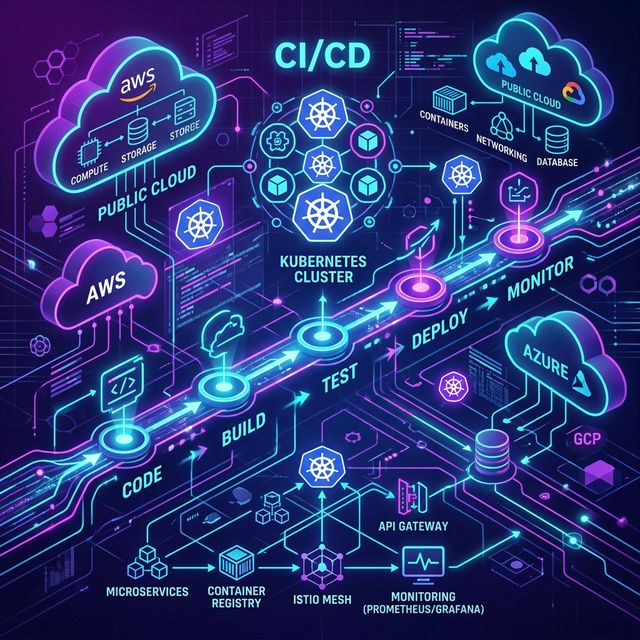
Expert DevOps Engineering Services
PixoBots DevOps engineering covers infrastructure automation, CI/CD pipelines and cloud optimization, delivered by dedicated DevOps engineers who work with AI tools. AI drafts Terraform, Bicep and Helm code, pipeline YAML and runbooks and speeds up log and incident triage; your engineer reviews and tests every change, so reliable delivery is in place sooner.
Our DevOps Services
We provide a comprehensive suite of services to transform your engineering culture and operations.
Infrastructure as Code
We use tools like Terraform and CloudFormation to automate the provisioning and management of your infrastructure.
CI/CD Pipeline Automation
We build robust CI/CD pipelines using tools like Jenkins, GitLab CI, and GitHub Actions to automate software delivery.
Cloud Migration
We help you migrate your applications to the cloud and manage your cloud infrastructure for optimal performance and cost.
Containerization
We use Docker and Kubernetes to containerize your applications and manage them at scale for high availability.
Monitoring & Logging
We set up comprehensive monitoring and logging solutions using tools like Prometheus, Grafana, and ELK stack.
DevSecOps
We integrate security into your DevOps processes, so security and compliance checks run on every change to your applications and infrastructure.
We Align Technology With
Strategic Business Objectives
"Through our specialized DevOps services, we align your technology stack with strategic goals, resulting in reduced time-to-market and improved reliability."

DevOps Is More Than Just Tools
It's about culture, processes, and people. Our engagement model focuses on bridging the gap between development and operations teams to create a unified engineering force.
-
Faster Time-to-Market
Ship smaller updates, more often.
-
Reduced Downtime
Automated recovery and stability.
-
AI-Augmented Engineers
Dedicated engineers who use AI for IaC and pipelines, and review every change.
-
Improved Scalability
Infrastructure that grows with you.
Service Management Principles
Our roadmap for taking your organization to DevOps maturity.
| Management Process | What It Is | Outcome |
|---|---|---|
| Release Management | Planning, scheduling, and controlling software builds. | Stable Deployments |
| Configuration Management | Keeping servers and environments in a known, consistent state. | Reduced Infrastructure Drift |
| Change Management | Standardized methods for efficient handling of changes. | Reduced Risk |
Our DevOps Platform
Config Management
ANSIBLE
PUPPET
CHEF
Plan & Provision
TERRAFORM
DOCKER
PACKER
Continuous Delivery
JENKINS
GITLAB CI
SPINNAKER
Continuous Visibility
PROMETHEUS
GRAFANA
ELK STACK
Process of Our DevOps Engineering Services
Discover
Analyze existing workflows and tech stack.
Plan
Strategy design for automation and migration.
Execute
Implementing CI/CD and IaC guardrails.
Monitor
Continuous visibility and optimization.
What a DevOps Engagement Covers
A DevOps engagement usually begins with an assessment of how code gets from a developer's laptop to production today: branching strategy, build and test steps, environments, manual approvals, how infrastructure is created and what happens when something breaks. That baseline exposes the real bottlenecks — often a slow test suite, hand-built servers or a release process that depends on one person — and sets the order of work.
From there the work typically spans four tracks: infrastructure as code so environments are reproducible; CI/CD pipelines that build, test, scan and deploy every change the same way; observability so teams can see how systems behave in production; and incident response so failures are detected, handled and learned from. Documentation and runbooks are delivered alongside the code so your team can own and extend everything — and you own all of the code and IP.
Infrastructure as Code and Pipelines That Hold Up
With Terraform, OpenTofu, CloudFormation, Bicep or Pulumi, infrastructure changes go through the same review as application code: a pull request shows the planned diff, a pipeline applies it, and state is stored remotely with locking. We structure code into reusable modules per environment, keep secrets in a vault or the cloud provider's secret manager rather than in variable files, and add drift detection so manual console changes are caught.
Pipelines are designed for fast feedback — unit tests and static analysis first, slower integration and end-to-end tests later — with build artefacts created once and promoted through environments rather than rebuilt for each one. Progressive delivery techniques such as blue-green deployments, canary releases and feature flags reduce the blast radius of a bad release and make rollback a routine step instead of an emergency.
Observability, Incidents and Measuring Progress
Observability combines metrics, logs and traces — often collected with OpenTelemetry and viewed in Prometheus and Grafana, an ELK or OpenSearch stack, or a cloud-native service. Alerts are tied to service level objectives that reflect what users experience, such as error rate and latency, rather than every CPU spike, which keeps on-call noise down. Incident response adds clear severity levels, escalation paths, runbooks for common failures and blameless post-incident reviews that turn outages into backlog items.
To see whether delivery is actually improving, many teams use the delivery metrics popularised by the DORA research programme: deployment frequency, lead time for changes, change failure rate and the time it takes to recover from a failed deployment. We help you capture them from your own pipeline and incident data, establish a baseline and track the trend over time. The aim is steady, measurable improvement in your context, not a vanity target.
Pixel-perfect software, delivered at AI speed
PixoBots stands for Pixel & Bots. Our Bots are dedicated developers who work with AI tools: AI takes the repetitive work, a developer reviews every line, and the result is pixel-perfect.
Pixel
Polished UI and clean, tested code - detail is part of the job, not an afterthought.
Bots
Dedicated developers who join your team and use AI for boilerplate, tests and documentation.
Savings
AI-assisted delivery can save more than 50% of development cost compared with traditional development.