
Applications Support & Maintenance Services
At PixoBots, our maintenance services include patching, bug fixes, and performance tuning to keep your applications running smoothly. We can also set up monitoring and run security reviews to reduce the risk of unplanned downtime.
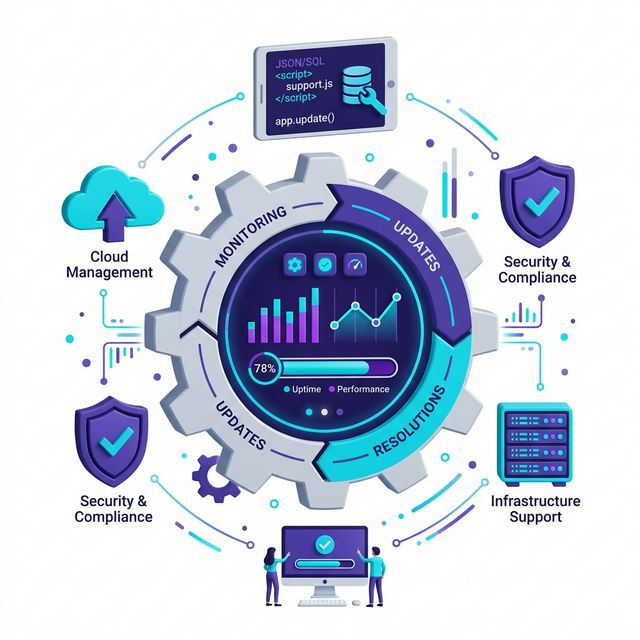
Our Services
Software Support
Application support with agreed response times by severity, so issues are handled in the right order.
AI-Assisted Maintenance
Your dedicated developer uses AI tools to trace root causes faster and draft dependency and framework upgrades, then reviews and tests every change before release.
System Monitoring
Monitoring and alerting set up for your systems, so issues are spotted early and can be handled before they affect your business.
Application Improvement
Improving the performance, usability and code quality of your existing applications.
Regulatory Updates
Code and documentation changes that keep your software aligned with the regulations that apply to it, such as GDPR - compliance sign-off stays with your team.
Migration of a Server
Migrating your applications to a new server or hosting platform, with a planned cutover and a rollback path.
We Cover All
Maintenance & Support Challenges
Expert handling of each type of maintenance to support your business continuity.
Corrective Maintenance
Reactive fixes for system errors and bugs that affect business operations.
Adaptive Maintenance
Updates to keep systems compatible with evolving environments and technologies.
Ad-hoc Maintenance
Specialized support tasks and configuration changes on an as-needed basis.
3rd Party
Application Takeover
Our structured 3-phase process for handing over and stabilizing your software.
Transfer
Full audit of source code, infrastructure, and technical documentation for a smooth handoff.
Remedy Activities
Prioritized fixes for the critical bugs, security gaps and performance bottlenecks identified in Phase 1.
Maintenance & Support
Transition to steady-state operations, with monitoring in place and a dedicated support team.
Engagement Models
What a Support Plan Actually Covers
Not a retainer that buys you a phone number — the work that keeps a system healthy.
Monitoring & Alerting
Uptime and performance monitoring across servers, databases, APIs and CDNs, with alerting so incidents are noticed quickly and automated runbooks where recovery can be scripted.
Security Patching
Automated vulnerability scanning and dependency checks. We apply OS-level, framework and library patches on a tested schedule, so your application keeps up with security fixes while changes are tested for regressions.
Performance Tuning
Performance reviews covering Core Web Vitals, database query analysis, cache hit-rate optimisation and infrastructure right-sizing, aimed at finding bottlenecks before they affect your end users or search rankings.
Backup & Disaster Recovery
Backups with point-in-time restore where your platform supports it, offsite copies and restore checks. We document your RTO and RPO targets so you know what to expect when things go wrong.
Bug Fixes & Minor Updates
Development time for small changes, agreed as part of your plan. Use them for bug fixes, small feature additions, content updates, or UI tweaks — managed through a prioritised ticket queue with clear response expectations.
Reporting & Transparency
Regular reports covering uptime, incidents, security findings, performance trends and time spent. You always know exactly what we did, why we did it, and what's coming next.
Taking Over a Codebase You Did Not Build
Inherited applications rarely arrive with complete documentation. The previous vendor may have left, the original developer may be unreachable, and credentials are often scattered across personal accounts. The first job is access and inventory: source repositories, hosting and DNS accounts, domain and certificate renewals, third-party API keys, backups, and the build and release process. Anything still owned by a former supplier is moved into accounts you control.
Next comes an honest assessment. We check whether the code in the repository actually matches what is running in production, list outdated frameworks and libraries with known vulnerabilities, identify untested critical paths such as checkout or login, and note where the design will make change expensive. The result is a prioritised list - fix now, schedule, or accept - rather than a recommendation to rewrite everything.
How to Scope a Support Agreement That Works
The useful questions are concrete. Which systems and environments are in scope, and which belong to someone else? What counts as an incident versus a change request? Who can raise tickets, through which channel, and who on your side decides priority when two things are urgent? How are hours for small enhancements tracked, and what happens to unused or overrun hours?
Response expectations should be written down per severity and matched to what the business genuinely needs - an internal reporting tool and a revenue-critical store do not need the same cover, and paying for out-of-hours cover you will not use is a common waste. We agree these terms with you before work starts, keep pricing transparent and milestone-based for any larger improvements, and you keep full ownership of the code and IP throughout.
Dependency Upgrades and Incident Handling
Most long-lived applications fail slowly rather than suddenly. A runtime or framework reaches end of support, a library stops receiving security fixes, a payment provider retires an API version, or a mobile store raises its minimum SDK level. Treating these as scheduled, small upgrades - one major version at a time, tested in a staging environment that mirrors production - is far cheaper than an emergency migration when something stops working.
When an incident does happen, a clear routine matters more than heroics: confirm the impact, restore service first (often by rolling back the last release or failing over), communicate status to the people affected, and only then dig into root cause. Each significant incident should end with a short written review and a follow-up fix - an alert that would have caught it sooner, a missing test, or a configuration change - so the same failure does not recur.
Pixel-perfect software, delivered at AI speed
PixoBots stands for Pixel & Bots. Our Bots are dedicated developers who work with AI tools: AI takes the repetitive work, a developer reviews every line, and the result is pixel-perfect.
Pixel
Polished UI and clean, tested code - detail is part of the job, not an afterthought.
Bots
Dedicated developers, trained in-house on AI tools, who join your team and use AI for boilerplate, tests and documentation.
Savings
AI-assisted delivery can save more than 50% of development cost compared with traditional development.